
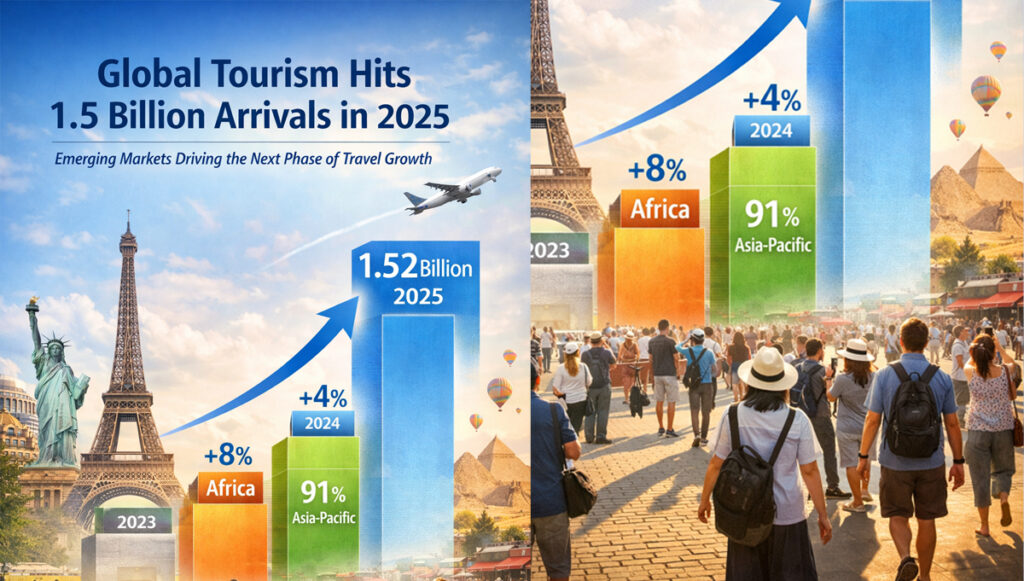
International tourism rebounded strongly in 2025, with global arrivals reaching 1.52 billion, marking a 4% year-on-year increase, according to the latest World Tourism Barometer released by the World Tourism Organization.
The milestone confirms that global travel has not only stabilised after years of volatility but is now entering a phase of structured growth led by emerging markets and regional diversification.
Key Growth Signals
- Africa emerged as the fastest-growing region, recording an 8% increase in international arrivals, reflecting stronger air connectivity and renewed leisure demand.
- Asia & the Pacific continued its recovery trajectory, reaching nearly 91% of pre-pandemic levels as long-haul travel corridors further reopened.
- Mature destinations in Europe and the Middle East maintained steady performance, supported by strong intra-regional travel flows.
Industry analysts interpret the 1.5-billion mark as a psychological and structural turning point for global tourism. The recovery is now being driven less by pent-up demand and more by sustained outbound travel, premium leisure spending and expanded air capacity across key corridors.
Why This Matters for the Industry
- Airlines are responding with network expansion, particularly linking Asia, Africa and the Middle East.
- Hotel groups are accelerating development pipelines in secondary cities and emerging destinations.
- Destination marketing organisations are shifting focus toward higher-yield segments and diversified source markets.
With demand patterns stabilising and new growth engines emerging beyond traditional Western markets, 2026 is expected to see continued momentum—though geopolitical and economic variables remain watch factors.