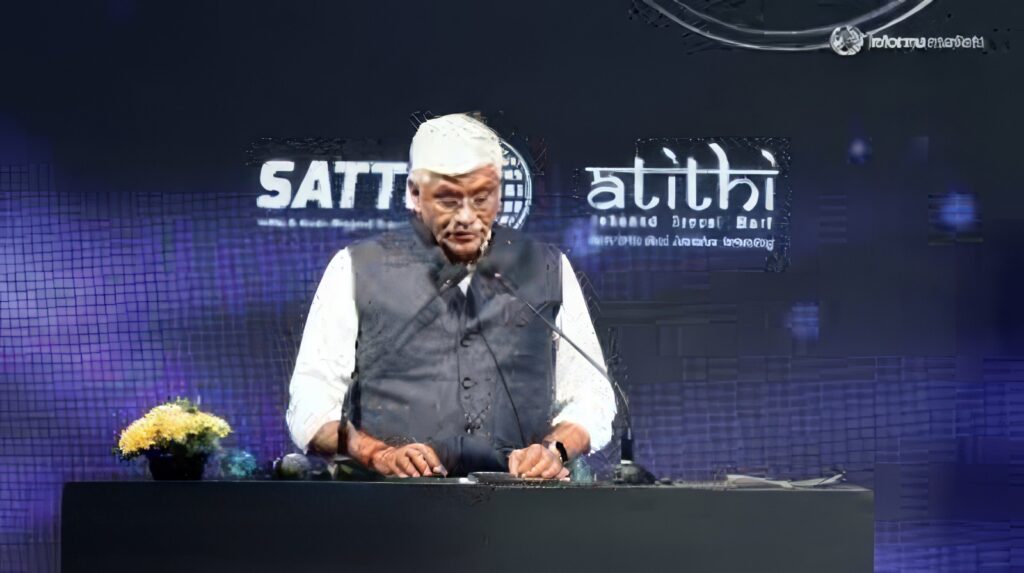
Speaking at SATTE 2026 at Yashobhoomi, the Union Minister of Tourism, Gajendra Singh Shekhawat Government of India, declared that India’s tourism movement has reached a historic inflection point, asserting that the country is no longer on the margins of global travel growth but is helping shape its future.
Calling SATTE’s 33-year journey a milestone in itself, the Minister said the platform has gone beyond exhibitions to build conversations, partnerships, and tourism corridors across India and the South Asia Pacific region. However, he emphasized that this year’s gathering is special because “India’s tourism movement has arrived.”
From Destinations to Experiences
Highlighting a fundamental shift in global travel behavior, the Minister noted that tourists today are no longer seeking just destinations but stories, culture, authenticity, wellness, nature, and meaningful human connections. “When the world searches for experiences, it inevitably discovers India,” he said, describing the country as a civilization of thousands of years, a democracy of aspiration, and an economy of rising opportunity.
India, he stressed, offers unmatched diversity — from spiritual circuits to adventure tourism, heritage cities to modern convention infrastructure — delivering tourism at a scale few nations can rival.
Tourism at the Centre of National Development
Under the leadership of Prime Minister Narendra Modi, tourism has moved “from the margins of policy to the centre of national development,” the Minister stated. Tourism, he said, is not merely about travel; it generates livelihoods, empowers communities, strengthens cultural confidence, and drives inclusive economic growth.
Each tourist arrival creates opportunities for guides, artisans, drivers, homestay owners, and young entrepreneurs. In that sense, tourism democratizes development and plays a vital role in India’s journey toward Viksit Bharat 2047.
Infrastructure Push and Policy Backing
India’s tourism growth, he asserted, is supported by clear policy direction and unprecedented infrastructure expansion.
Through Swadesh Darshan 2.0, destinations are being developed around sustainability, local culture, and ecological sensitivity. The PRASAD Scheme has transformed pilgrimage infrastructure across the country.
He cited large-scale rejuvenation projects in Kashi and the Mahakal Lok Ujjain corridor as examples of how spiritual tourism has been elevated to world-class standards. Referring to Ayodhya, he claimed that the city alone witnessed nearly 70 million visitors last year, while Ujjain’s pilgrim numbers have surged from a few lakhs to multiple crores following redevelopment.
Domestic Tourism: India’s Core Strength
Under the Dekho Apna Desh initiative, domestic tourism has reached unprecedented levels, bringing economic vitality to Tier 2 and Tier 3 cities. This strong internal market, the Minister said, makes India one of the most resilient tourism economies globally.
Simplified travel procedures, expanded e-visa facilities, digital public infrastructure, improved airports, highways, railways, and enhanced regional air connectivity under the UDAN Scheme are unlocking previously untapped destinations.
Mega infrastructure such as Yashobhoomi and Bharat Mandapam signal India’s emergence as a global hub for exhibitions, conventions, and large-scale events.
A Direct Pitch to Global Investors
Addressing investors at SATTE under the theme “An Opportunity Called India,” the Minister described the phrase as factual rather than aspirational. India is among the fastest-growing major economies, with a young population, expanding middle class, robust digital public infrastructure, stable policy frameworks, and long-term growth visibility.
Tourism and hospitality permit 100% Foreign Direct Investment under the automatic route. States across India, he said, are offering progressive tourism policies, land support, and single-window approvals.
Investment opportunities span destination resorts, heritage properties, eco and rural tourism, cruise tourism, medical and wellness tourism, MICE, wildlife tourism, gastronomy tourism, trekking, train journeys, and adventure tourism.
Culture as India’s Greatest Tourism Asset
In his dual role as Minister of Culture and Tourism, he underscored that India’s civilization is its greatest tourism asset. Monuments are living narratives, festivals are immersive experiences, and crafts, music, and traditions create emotional connections for travellers.
Through museum modernization, heritage conservation, digital archives, and cultural revitalization, India is building an experience-led tourism ecosystem integrated into global travel value chains via platforms such as the Atithi Tourism and Hospitality Expo.
The Road Ahead: Sustainable and Technology-Driven
The future of Indian tourism, he concluded, will be defined by sustainability, technology integration, skill development, innovation, and community participation. The objective is clear: growth that benefits people, protects the planet, and positions India as a responsible global tourism leader.
Inviting international partners not just as visitors but as collaborators, he declared, “This is India’s tourism decade.”
SATTE 2026, marking over three decades of excellence, stands — in his words — not merely as an event, but as a statement of a nation confident about its future and ready to lead the next era of global travel.
Jai Hind.