
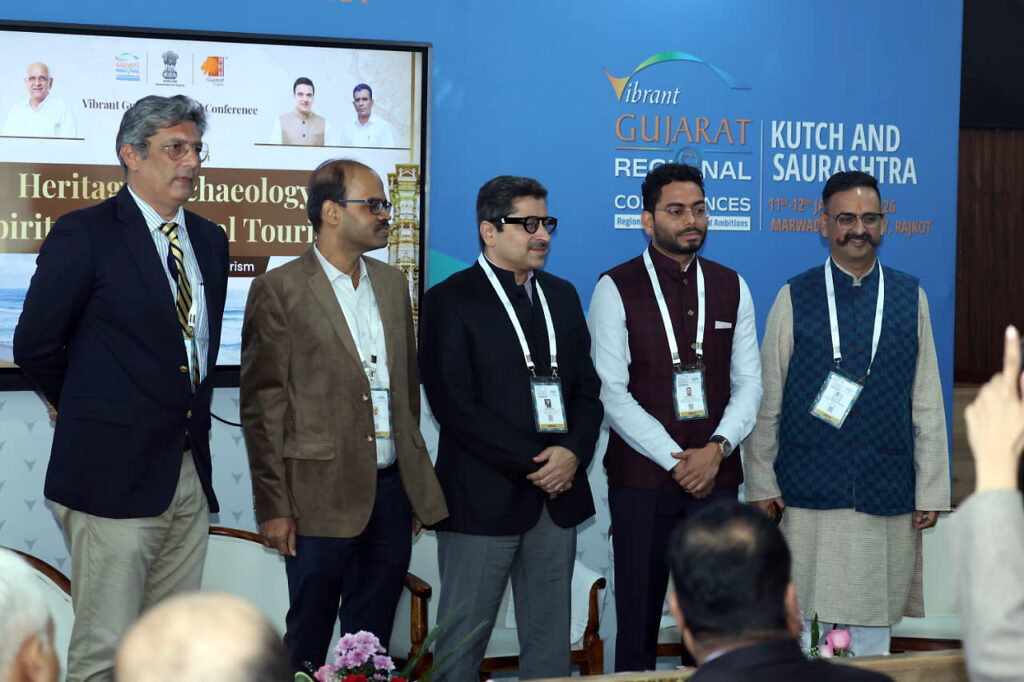
Shri Giresh Vasudev Kulkarni, Founder of Temple Connect and the International Temple Convention & Expo (ITCX), emerged as a prominent voice at the Vibrant Gujarat Regional Conference 2026, highlighting the growing national importance of structured and sustainable spiritual tourism. He was addressing the featured conference titled “Unravelling Gujarat’s Treasure: A Journey Through Spirituality, Heritage, Archaeology, and the Sea”, held on January 12, 2026, at Marwadi University, Rajkot.
The Vibrant Gujarat Regional Conference for the Saurashtra and Kutch region was inaugurated a day earlier by Hon’ble Prime Minister Shri Narendra Modi. Conceived under his visionary leadership in 2003, the Vibrant Gujarat initiative has evolved into one of India’s most influential platforms for policy dialogue, investment facilitation and long-term development partnerships.
The session explored Gujarat’s deep spiritual legacy, rich cultural heritage, archaeological wealth and vast coastal potential, positioning them as key drivers of sustainable tourism and regional economic growth. A major highlight of the conference was the panel discussion on “Holistic Path of Spiritual Tourism”, during which Shri Giresh Kulkarni introduced the CHESS-G Doctrine, a six-pillar strategic framework aimed at reimagining India’s temple towns and pilgrimage destinations.
The CHESS-G Doctrine is built on six core pillars — Convenience, Hygiene, Experience, Sustainability, Safety and Economic Growth. The framework advocates a shift from footfall-driven temple management to an experience-led and community-centric approach, ensuring that spiritual tourism strengthens both faith and livelihoods while preserving the sanctity of sacred spaces.
Elaborating on the framework, Shri Kulkarni emphasised that pilgrim convenience must be prioritised through better infrastructure, smoother mobility and digital support systems. Hygiene, he said, should be treated as an integral part of the spiritual experience, with high standards of sanitation, food safety and clean water across temple towns. Experience was highlighted as the soul of spiritual tourism, focusing on dignified darshans, cultural storytelling and immersive devotional journeys.
Safety formed another critical pillar, encompassing crowd management, disaster preparedness, medical readiness and special attention to women, senior citizens and first-time pilgrims. Sustainability focused on environmentally responsible development, including waste and water management, green temple practices and heritage conservation. The final pillar, economic growth, stressed inclusive development by enabling livelihoods for local communities, artisans, vendors, MSMEs and temple custodians.
Addressing the gathering, Shri Giresh Kulkarni noted that while Gujarat receives a massive volume of pilgrims every year, success in spiritual tourism cannot be measured by numbers alone. He underlined the need to build sacred ecosystems where faith, heritage, sustainability and local economies grow together.
The conference also featured participation from senior policymakers, tourism leaders and industry stakeholders, reinforcing Gujarat’s vision of integrating spirituality, culture and economic progress. Shri Kulkarni’s address resonated strongly with this vision, positioning temple towns not merely as places of worship but as cultural anchors and economic engines of civilisation. His message called upon policymakers, temple trusts and planners to move beyond crowd management and begin building future-ready sacred cities that function spiritually, socially and economically.