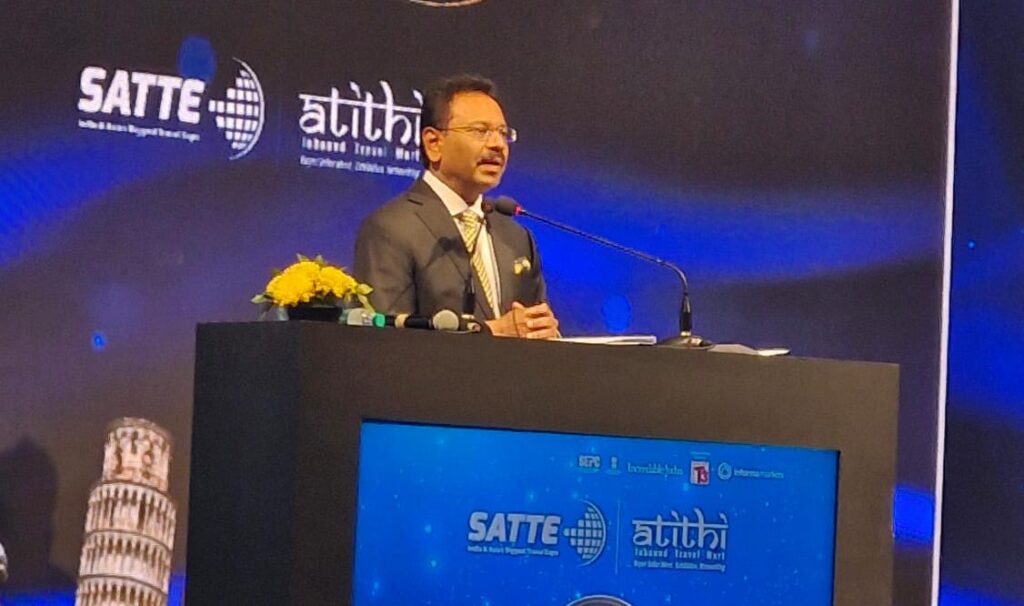
At SATTE 2026, Suman Billa, Additional Secretary, Ministry of Tourism, Government of India (and Director General, Tourism), positioned India as one of the most attractive long-term tourism investment markets globally, citing strong demand fundamentals, rapid infrastructure expansion, and a forthcoming national tourism digital stack.
Praising the evolution of SATTE into a world-class platform, he noted that the state-of-the-art infrastructure at Yashobhoomi enables India to host global-standard trade events. He commended the organizers and industry partners for nurturing the event into a flagship property.
Demand Outstripping Supply
Billa highlighted India’s unique tourism economics:
- 20 million inbound tourists generating approximately $32 billion in foreign exchange
- 30 million outbound Indian travellers spending nearly $37 billion overseas
- A rapidly expanding domestic market, which he described as the “real story”
He stated that India’s domestic tourism economy saw an extraordinary surge last year, reinforcing the fact that demand is significantly outpacing supply — making India one of the most favourable markets globally for tourism investment.
“India is at the beginning of a long-term growth cycle,” he said, urging investors present to take confidence in their decision to engage with the Indian market.
Track One: Enabling Ease of Travel
Under the leadership of Union Tourism Minister Gajendra Singh Shekhawat, the Ministry is working on two strategic tracks.
The first focuses on ease of travel. While India now boasts world-class highways, a doubling of operational airports from 75 to 150 in the past decade (with another 30–40 expected in the next five years), modernized airports, premium hotels, and high-speed Vande Bharat Express services, Billa acknowledged the need to enhance predictability and seamlessness for travellers.
To address this, the Ministry is developing an India Tourism Digital Stack, leveraging the country’s digital public infrastructure:
- Digi Yatra for seamless, facial-recognition-based airport processing
- DigiLocker for credential verification
- Unified Payments Interface (UPI) to enable frictionless transactions for international visitors
- Open Network for Digital Commerce (ONDC) to integrate even the smallest tourism players into a globally discoverable marketplace
The objective, he said, is to make travel across India seamless, transparent, and digitally empowered.
Track Two: Ease of Doing Business
The second strategic focus is improving ease of doing business. India currently has an estimated 1.8 lakh branded hotel rooms and 15 lakh unbranded rooms, while demand is projected to be nearly double existing supply.
Billa revealed that the Ministry is working closely with industry leaders to remove regulatory bottlenecks, introduce deregulation measures, ensure predictable licensing outcomes, and encourage states to redesign capital structures with incentives and subsidies.
“If we are able to unleash market forces,” he stated, “we will be where we need to be.”
A Direct Message to Investors
Concluding with a clear investor pitch, Billa told delegates that India’s current tourism momentum represents only “the tip of the iceberg.”
His advice: take a long-term view, be ambitious, and invest where opportunity is expanding structurally.
“You have chosen wisely to be here,” he said, expressing confidence that those betting on India today will see substantial returns in the years ahead.
Jai Hind.