India has temporarily halted visa operations at its mission-linked facilities in Chittagong as unrest continues to escalate in parts of Bangladesh, even as the Ministry of External Affairs (MEA) in New Delhi pushed back strongly against what it described as “misleading propaganda” surrounding a separate protest incident in India.
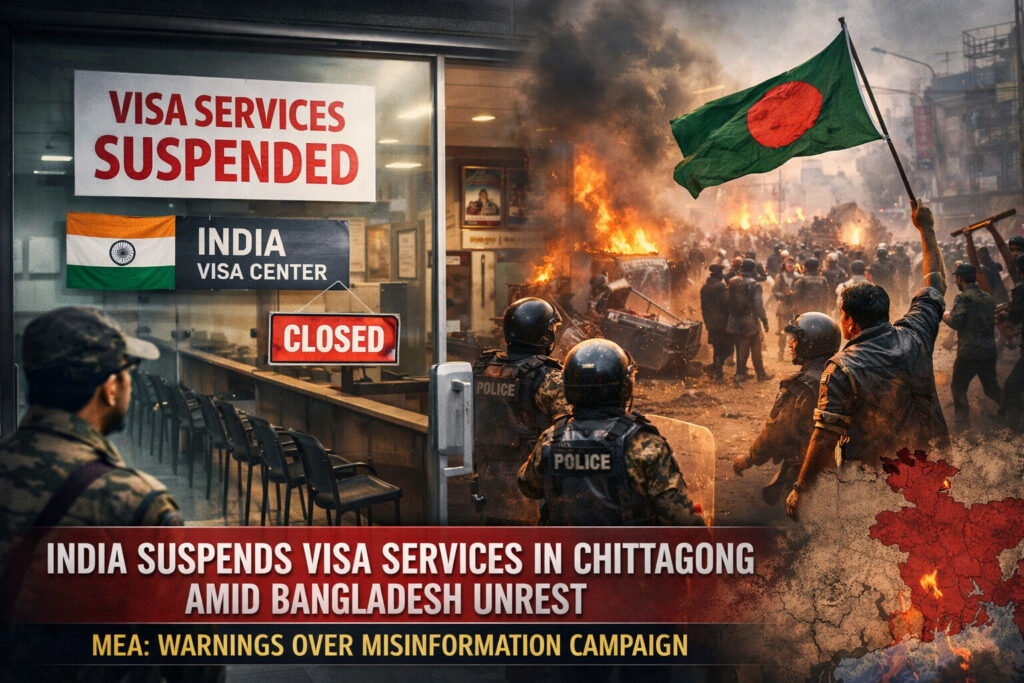
The Indian Visa Application Centre (IVAC) in Chittagong announced the suspension of services from Sunday, citing security concerns following disturbances near the Assistant High Commission of India (AHCI). Authorities confirmed that visa processing will remain on hold until the situation is reviewed and deemed safe.
The move follows late-night protests in Chittagong’s Khulshi area, where demonstrators gathered outside the Indian mission premises in response to the killing of Bangladeshi youth leader Sharif Osman Hadi. Police intervention to disperse the crowd reportedly led to injuries, including to a police officer, prompting an immediate tightening of security around the Indian diplomatic post.
In its advisory, the IVAC stated that the decision was taken purely on security grounds and that a reopening announcement would be issued once conditions stabilise.
Meanwhile, in New Delhi, the MEA rejected reports circulating in sections of the Bangladeshi media suggesting a security breach at the Bangladesh High Commission. Clarifying the incident, the ministry said a small group of around 20–25 protesters had briefly assembled outside the High Commission on 20 December to condemn the lynching of Dipu Chandra Das, a Hindu man killed in Mymensingh, and to demand protection for minorities in Bangladesh.
“There was no attempt to breach security or damage property,” the MEA said, adding that the gathering was dispersed peacefully by local police within minutes.
Reiterating India’s diplomatic obligations, the MEA stressed that the safety of all foreign missions in India is ensured strictly in line with the Vienna Convention. It also confirmed that Indian officials are in constant touch with Bangladeshi authorities, conveying serious concerns over recent attacks on minorities and urging swift legal action against those responsible for the killing of Das.
The developments come against the backdrop of widespread protests across Bangladesh, several of which have targeted Indian diplomatic establishments. In recent days, security has been reinforced outside Indian missions following attempts by demonstrators to march towards diplomatic residences, including that of India’s Deputy High Commissioner in Dhaka.
Protests were also reported in Rajshahi and Shahbagh, where police blocked access to Indian facilities amid slogans and stone-pelting incidents captured in social media videos. Some demonstrators accused India of sheltering the alleged attackers involved in Hadi’s killing—claims for which Bangladeshi authorities have yet to present conclusive evidence.
The unrest intensified after confirmation that Hadi, who had been undergoing treatment in Singapore following a shooting earlier this month, had succumbed to his injuries. The fallout included arson attacks on prominent media houses and renewed violence in Dhaka and other cities.
Bangladesh’s interim chief adviser Muhammad Yunus announced a national day of mourning following Hadi’s death, with special prayers held nationwide. His funeral took place at Dhaka University on Saturday.
As tensions continue to simmer, India remains closely monitoring the situation, balancing diplomatic engagement with heightened security measures across its missions in Bangladesh.