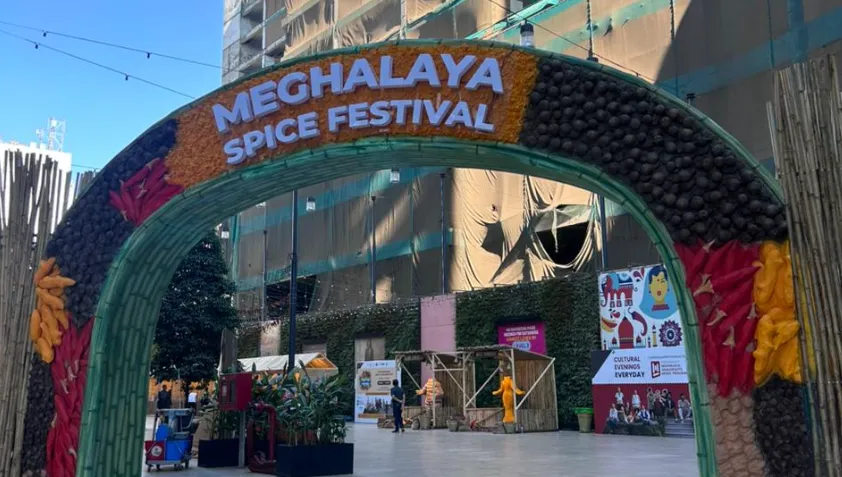
In a move that blends agriculture, culture and destination branding, Meghalaya brought its organic spice economy to the national spotlight with the inaugural Meghalaya Spice Festival at Jio World Drive in Bandra Kurla Complex — positioning the State not just as a supplier of premium produce, but as an emerging experiential travel narrative.
While the event functioned as a serious market-linkage platform, its larger travel significance lies in how Meghalaya is shaping a new identity — where spices, sustainability and community tourism converge.
A 140-member delegation of farmers, entrepreneurs, cooperative leaders and officials travelled from the State to engage directly with buyers, exporters and institutional partners. Strong footfall and sustained buyer–seller interactions marked the opening day, alongside structured discussions linking spices with tourism promotion. Live processing demonstrations, tasting counters and curated retail displays turned the venue into an immersive showcase — offering urban consumers a sensory preview of Meghalaya’s agri-landscape.
For travel planners and destination marketers, the message was clear: Meghalaya is not merely exporting turmeric and ginger; it is exporting an ecosystem.
Dr. Shakil P. Ahammed, IAS, Chief Secretary, Government of Meghalaya, underlined the authenticity of the State’s agricultural base, encouraging stakeholders to experience it firsthand. His remarks subtly reinforced a growing tourism opportunity — farm visits, organic trails and community-led rural experiences rooted in ecological stewardship.
Dr. Vijay Kumar D., IAS, Commissioner & Secretary, Agriculture & Farmers’ Welfare Department, highlighted Meghalaya’s expanding global footprint. The State’s turmeric is already reaching markets across America, the Middle East and Europe, while ginger exports have recently reached Singapore. He stressed the importance of sustainable partnerships and fair pricing for farmers — an approach that aligns closely with the growing global demand for responsible and origin-based travel experiences.
At the centre of this transformation is GI-tagged Lakadong Turmeric, known for its 7–12 per cent curcumin content. Under the Lakadong Mission, cultivation has expanded to 2,190 hectares, supported by more than 20 processing units benefiting over 13,000 farmers. Between 2022 and 2025, over 420 metric tonnes of spices have been traded across domestic and export markets — reflecting a scale that supports not just trade, but tourism storytelling.
Smti. N. Bhavani Sri, IAS, Secretary of the National Turmeric Board, described the initiative as a structured effort to harness the North-East’s agri-ecosystem through farmer collectivisation, branding and post-harvest improvements. She noted growing exporter interest in Lakadong turmeric for high-value curcumin extract and turmeric oil segments, reinforcing Meghalaya’s potential within the global wellness economy — a segment increasingly intertwined with travel.
Cultural performances under the Chief Minister’s Meghalaya Grassroots Music Programme added depth to the showcase, presenting a layered narrative of agriculture, music and community enterprise. For the travel industry, this fusion signals a maturing destination strategy: linking farm economies with cultural capital and visitor engagement.
Agriculture’s contribution to Meghalaya’s Gross State Domestic Product has more than doubled over the past six years, rising from ₹5,977.91 crore in 2018–19 to ₹12,332.26 crore in 2024–25. Under the leadership of Chief Minister Conrad K. Sangma, the State is positioning spices, tourism and the creative sector as integrated drivers of inclusive growth — part of a broader ambition to become a USD 16 billion economy by 2032.
For the travel fraternity, the takeaway is strategic. As culinary tourism, wellness retreats and farm-to-table experiences gain traction globally, Meghalaya’s organic spice ecosystem offers the foundation for curated spice trails, village stays and agri-learning itineraries that extend beyond sightseeing.
The festival continues at Jio World Drive until March 1, but the larger journey is only beginning — one where Meghalaya’s spice routes may soon translate into new travel circuits linking soil, story and sustainability.