
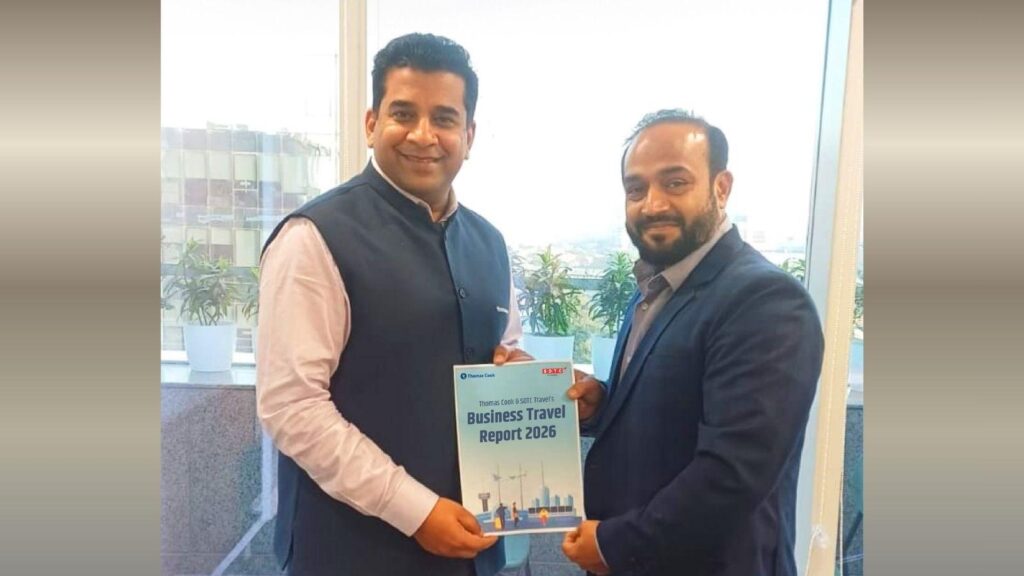
Business travel across Corporate India is poised for continued growth in 2026, with nearly 65% of enterprises expecting an increase in travel volumes over the next 12 months, according to the Business Travel Report 2026 released by Thomas Cook (India) Limited and its group company SOTC Travel.
The report — based on insights from over 25 leading enterprises across sectors including BFSI, manufacturing, healthcare, hospitality, conglomerates and professional services, supported by internal booking and transactional data — highlights a resilient demand environment coupled with sharper cost controls and technology-led governance.
While 65% of corporates anticipate rising travel volumes, 30% expect stability and only 5% foresee a decline — translating to 95% projecting stable-to-growth spends. Client meetings, sales engagements and business-critical internal travel continue to drive demand, reinforcing travel’s role in revenue generation and relationship management.
Tech-Led Transformation
Over 70% of enterprises are increasing reliance on digital platforms for booking, approvals, expense management and MIS reporting. The shift toward data-driven oversight is enabling stronger policy compliance, better spend visibility and smarter decision-making.
The report notes that 62% of corporates are now prioritising value-driven travel management — balancing cost efficiency with safety, compliance and traveller well-being. Meanwhile, 56% emphasise improved traveller experience, flexibility and duty of care, particularly for frequent travellers and senior leadership.
Close to 60% of companies are revisiting or tightening travel policies, renegotiating airline and hotel contracts, and rationalising supplier networks to offset rising costs. Notably, 80% of respondents reported increased average ticket prices over the past year, with over one-third witnessing hikes exceeding 15%.
GST compliance and input tax credit (ITC) optimisation have also emerged as key focus areas for 55% of corporates, as tax complexities continue to impact travel budgets.
Bleisure on the Rise
The growing blend of business and leisure travel is becoming mainstream, with 68% of corporates observing employees extending work trips for personal time. This trend is prompting organisations to clarify cost-sharing norms and introduce greater flexibility within structured frameworks.
Domestic Dominance, International Revival
Domestic travel accounts for 72% of corporate movement, led by hubs such as Mumbai, Delhi-NCR, Bengaluru, Chennai, Hyderabad and Pune. Internationally, destinations including Singapore, Thailand, Hong Kong, Maldives, Dubai–Abu Dhabi, the UK, Italy, Netherlands, USA, South Africa and Australia remain key for leadership meetings and expansion initiatives, with China and Japan emerging strongly.
Commenting on the findings, Indiver Rastogi, President & Group Head – Global Business Travel, said the report reflects a decisive shift towards value-led programs, accelerated digital adoption and stronger governance structures. He highlighted innovations such as Dhruv.ai, a voice-enabled AI advisor, and TravelOne, an integrated booking and management platform, as part of efforts to build smarter, compliant and technology-enabled travel ecosystems.
The report positions 2026 as a year of calibrated expansion — where growth in corporate travel is being matched with discipline, compliance and digital transformation.