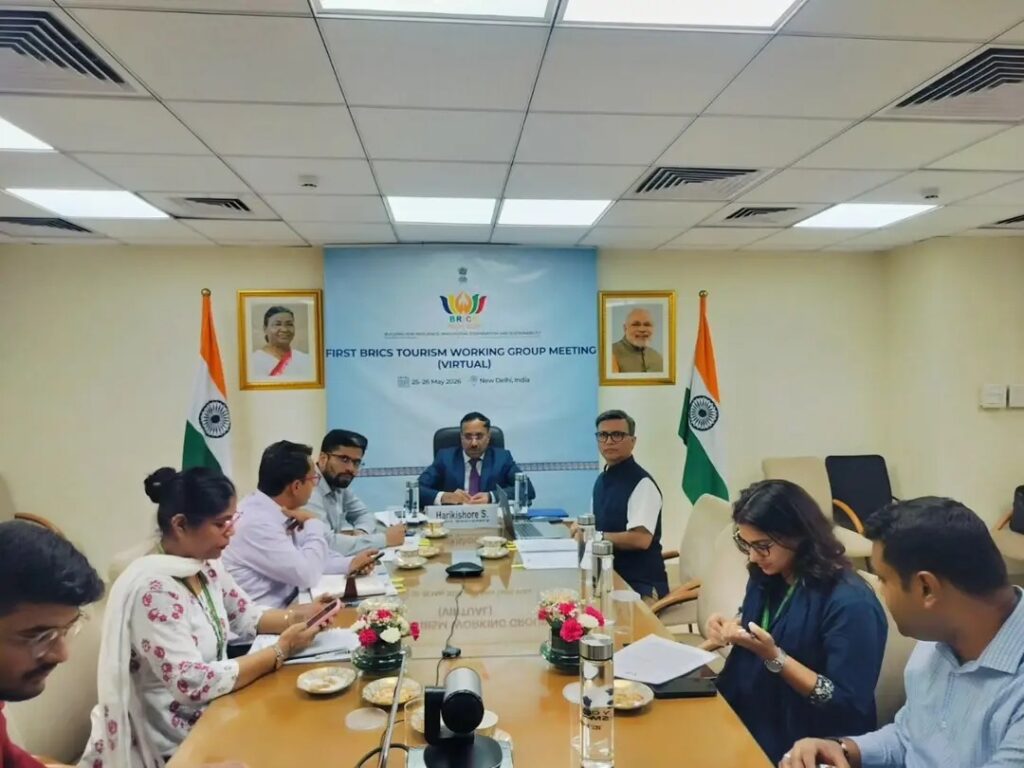
Ministry of Tourism, Government of India formally convened the first BRICS Tourism Working Group Meeting 2026 under India’s chairmanship on May 25, bringing together tourism representatives from BRICS member nations to shape a future-ready roadmap for global tourism cooperation.
The high-level virtual meeting was chaired by Shri Harikishore S., Joint Secretary, Ministry of Tourism, Government of India, and witnessed participation from Brazil, China, Egypt, Ethiopia, Indonesia, Iran, Russia, Saudi Arabia, South Africa and the UAE.
From the very outset, the discussions reflected India’s attempt to position tourism not merely as an economic activity, but as a strategic pillar for innovation, sustainability, skills development and cross-border collaboration in an increasingly technology-driven world.
According to the official agenda reviewed during the session, the BRICS Tourism Working Group focused on four major priority pillars for 2026 cooperation — Artificial Intelligence & Tourism, Sustainability & Responsible Tourism, Tourism Skilling & Capacity Building, and Tourism Exchanges & Seamless Travel Facilitation.
A detailed thematic presentation emphasized the growing role of Artificial Intelligence in building smarter and more responsive tourism ecosystems. Delegates discussed how digital tools and AI-driven systems could improve visitor experiences while also ensuring inclusivity, transparency and responsible governance within tourism economies.
Sustainability emerged as another central theme, with member nations stressing the need for eco-friendly, community-led and climate-resilient tourism models capable of balancing growth with environmental responsibility.
The working session also underlined the importance of tourism skilling, workforce development and institutional capacity building, especially as global tourism increasingly adopts digital technologies and experiential travel formats.
Another key focus area was seamless travel facilitation across BRICS nations, with discussions centered around improving tourism exchanges and enabling smoother cross-border travel flows in the future.
Officials noted that the meeting reflected a collective commitment among BRICS countries to deepen tourism cooperation in a global landscape shaped by rapid technological transformation, sustainability priorities and economic resilience.
The session concluded with a reaffirmed resolve among member nations to strengthen intra-BRICS tourism collaboration and identify practical, implementable areas of partnership with measurable outcomes.
Industry observers believe India’s leadership of the BRICS Tourism Working Group comes at a critical time when emerging economies are increasingly shaping the future direction of global tourism, travel technology and sustainable destination development.