
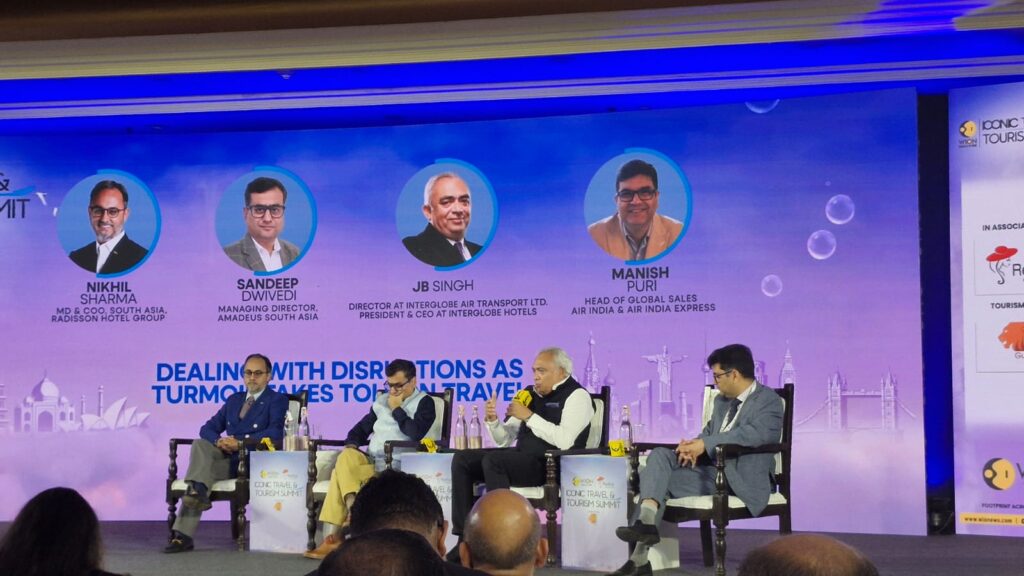
New Delhi: Amid ongoing global uncertainties and shifting travel patterns, industry stalwarts came together for a high-impact panel discussion on “Dealing with Disruptions: Coding the Resilience of the New Tomorrow” at the Iconic Travel & Tourism Summit 2026, offering sharp insights into how the sector is adapting to continuous change.
The session featured senior leaders including Manish Puri, JB Singh, Nikhil Sharma and Sandeep Dwivedi, who collectively highlighted that disruptions are no longer exceptions—but the new normal.
Aviation Takes the First Hit, But Recovery Remains Strong
Opening the discussion, Manish Puri pointed to multiple ongoing disruptions impacting aviation—from geopolitical tensions in the Middle East to crew shortages and global economic uncertainties.
He noted that airlines have been forced to rationalise operations and reduce frequencies to maintain operational integrity. “Long-haul travel, particularly on key routes like India–US, has seen pressure due to global uncertainties,” he said, adding that while the present scenario remains challenging, pent-up demand is expected to drive a strong rebound once stability returns.
‘Resilience is About Building Forward, Not Bouncing Back’
Taking the conversation forward, JB Singh brought a broader industry perspective, underlining that despite disruptions, the long-term growth trajectory of travel and tourism remains intact.
He highlighted that India’s strong domestic economy continues to fuel demand across sectors. “Post-pandemic, we saw unprecedented growth across travel segments, and that momentum continues. Globally, tourism is projected to become a $16 trillion industry by 2033,” he said.
Comparing sectors, Singh identified logistics as the most resilient, followed by hospitality due to its ability to pivot towards domestic and hyper-local demand. Aviation, he noted, remains the most vulnerable due to regulatory complexities and external shocks.
Domestic Markets Drive Stability Amid Global Volatility
From a hospitality lens, Nikhil Sharma emphasised that India’s domestic consumption remains the backbone of resilience.
He pointed out that while metro cities like Bengaluru and Hyderabad have seen a 25–27% dip in occupancy compared to last year due to global factors, Tier 2 and Tier 3 markets continue to outperform, showing growth of 3–4% year-on-year.
“Disruptions are here to stay. The real question is how prepared and resilient we are as an industry,” he said, adding that India’s domestic demand—particularly beyond metros—continues to provide stability during global slowdowns.
Traveller Behaviour Shifts Instantly in a Digital-First India
Offering a data-driven perspective, Sandeep Dwivedi highlighted how modern travellers are becoming increasingly adaptive and resilient.
He revealed that booking patterns shift within hours of a disruption, with travellers quickly exploring alternate routes and destinations. “Demand does not disappear—it gets redistributed,” he explained.
Sharing key data points, Dwivedi noted:
- Air ticket bookings are currently down by around 27% in affected segments
- However, when excluding labour traffic, the overall decline is minimal
- Emerging destinations like Vietnam have seen a massive 189% surge in bookings
- Airlines operating in Southeast Asia are witnessing significant growth as travellers shift preferences
He also pointed out that India’s digitally savvy population enables real-time behavioural shifts, making the market highly dynamic and responsive.
Travel Remains a Barometer of Economic Sentiment
A key takeaway from the discussion was that travel continues to act as a barometer of economic conditions. Corporate travel is often the first to decline during uncertainty, but leisure travel—especially among India’s growing middle class and Gen Z travellers—remains resilient.
Panelists agreed that rising disposable incomes and a strong aspiration for experiences are sustaining demand, even in the face of disruptions.
Disruptions Are the New Normal
The panel unanimously concluded that crises—whether geopolitical, economic, or operational—are now a constant feature of the global travel ecosystem.
However, the industry’s ability to adapt quickly, leverage technology, and tap into domestic demand is enabling it to stay resilient.
As the discussion underscored, the future of travel will not be defined by the absence of disruptions, but by how effectively the industry codes resilience into its operations, strategies, and customer experience.