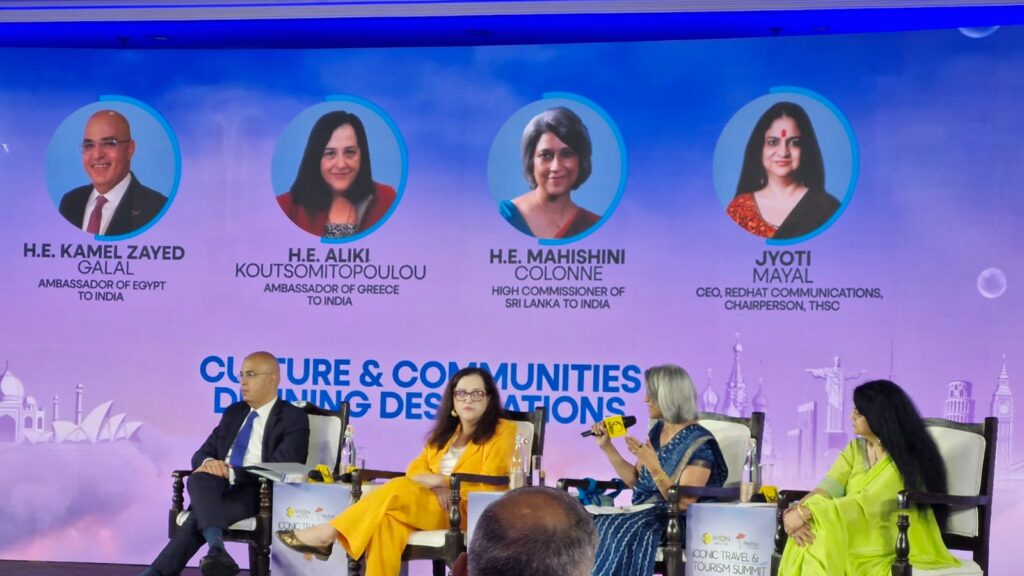
New Delhi: In a high-profile diplomatic panel at the Iconic Travel & Tourism Summit 2026, ambassadors from three major cultural nations—Kamel Zayed Galal, Aliki Koutsomitopoulou and Mahishini Colonne—joined Jyoti Mayal to discuss how culture and communities are redefining global tourism narratives.
The panel, themed “Culture & Communities Defining Destinations,” moved beyond conventional tourism discussions, placing civilizational connect, storytelling, and people-to-people engagement at the heart of future travel.
Tourism as a Cultural Message, Not Just an Economy
Opening the conversation, Egypt’s Ambassador Kamel Zayed Galal emphasized that tourism must be viewed as a human and cultural bridge rather than a commercial activity.
He highlighted the deep-rooted historical ties between India and Egypt, tracing connections back over 4,700 years, and stressed that tourism is fundamentally about tolerance, acceptance, and shared heritage.
“Egypt is not just about ancient monuments. Visitors must live Egypt—experience its people, its warmth, and its culture,” he said.
Importantly, he also noted that Egypt is not only preserving its past but actively building a modern tourism ecosystem, with new infrastructure and hospitality investments, including the entry of Indian brands like Taj Hotels.
Greece Moves Beyond Icons to Year-Round, Experiential Tourism
Greece’s Ambassador Aliki Koutsomitopoulou highlighted how the country is evolving beyond its globally recognized icons like Santorini to promote a more holistic and year-round tourism model.
With a record 38 million visitors last year, Greece is now focusing on:
- 365-day tourism
- Winter and mountain travel
- Golf and niche tourism segments
- Tailor-made experiential journeys
“Younger travellers are not just looking for destinations—they are looking for experiences,” she noted, adding that Greece is actively curating offerings that resonate with evolving global audiences, including India.
Sri Lanka Positions Itself as a Civilisational Extension of India
Offering a deeply rooted cultural perspective, Sri Lanka’s High Commissioner Mahishini Colonne described India and Sri Lanka as one shared civilizational space rather than separate geographies.
She highlighted:
- The Buddhist circuit connections between the two nations
- The Ramayana trail, spanning key sites across Sri Lanka
- Historical links between places like Anuradhapura, Bodhgaya, and Rameshwaram
“Sri Lanka and India are separated by just 30 kilometers of sea, but connected by millennia of history and storytelling,” she said.
She also underlined Sri Lanka’s unique advantage as a compact yet diverse destination, offering:
- 8 UNESCO World Heritage Sites
- Beaches, wildlife, and ancient cities within short travel distances
- Rare experiences like high leopard density and blue whale sightings
Experiential Tourism and Storytelling Take Centre Stage
A strong consensus across the panel was that global tourism is undergoing a shift toward experience-led and narrative-driven travel.
Ambassadors agreed that:
- Travellers today seek meaningful cultural immersion
- Storytelling is becoming central to destination branding
- Communities play a crucial role in shaping authentic experiences
This evolution is particularly visible among younger travellers, who prefer personalised and unique journeys over traditional sightseeing.
India’s Role as a Spiritual and Cultural Hub
Bringing the discussion closer home, Jyoti Mayal emphasized India’s growing role as a global spiritual and cultural ecosystem.
She highlighted the opportunity for India to collaborate with countries like Egypt, Greece, and Sri Lanka in promoting:
- Spiritual tourism circuits
- Cultural exchange programs
- Integrated heritage experiences
The focus, she noted, should be on positioning India not just as a destination, but as a cultural anchor in the global tourism narrative.
A Shared Civilizational Future for Tourism
The panel concluded on a powerful note—tourism in the coming decade will be defined not by destinations alone, but by shared histories, cultural identities, and human connections.
As global travel evolves, collaborations between culturally rich nations like Egypt, Greece, Sri Lanka, and India are set to create a new paradigm of tourism—one rooted in heritage, driven by experiences, and powered by communities.