
India is accelerating its transition towards becoming a global aviation hub, with Civil Aviation Minister Ram Mohan Naidu reviewing the readiness of Delhi Airport for the implementation of a hub-and-spoke model during a high-level meeting with key stakeholders.
The review is part of the government’s broader International Aviation Hub Strategy, which focuses on strengthening domestic carriers and positioning Indian airports as global transit points. Key measures under the strategy include a calibrated approach to granting Points of Call to foreign airlines, particularly for non-metro routes, renegotiation of bilateral air service agreements to favour Indian carriers, and liberalisation of domestic code-share arrangements to expand international connectivity.
Highlighting the long-term economic impact, the Minister stated that by 2047, the initiative could generate nearly 16 million direct and indirect jobs and contribute close to USD 1.4 trillion to the Indian economy.
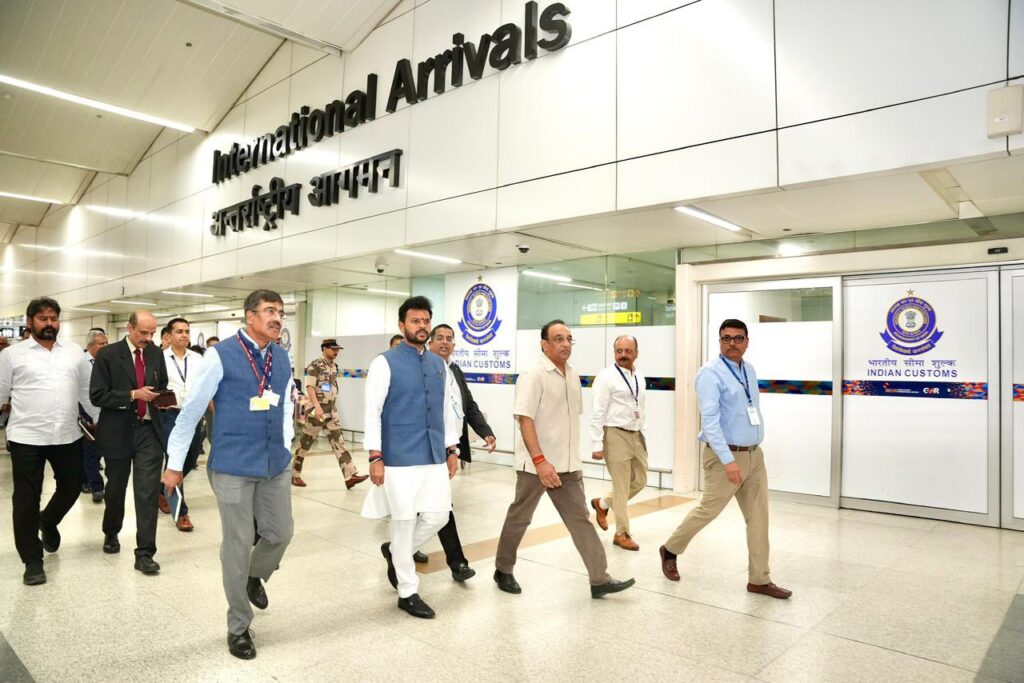
The meeting brought together senior officials from multiple agencies, including the Ministry of Civil Aviation, Ministry of Home Affairs, Bureau of Immigration, Bureau of Civil Aviation Security, Customs, Airports Authority of India, Directorate General of Civil Aviation, CISF, DigiYatra and Delhi International Airport Limited, along with leading airlines. The Minister also conducted an on-ground inspection of passenger flow systems and reviewed operations at the Security Hold Area in Terminal 3.
Explaining the model, Naidu said the hub-and-spoke system would enable seamless connectivity between Tier-II and Tier-III cities developed under the UDAN scheme and international destinations, while also ensuring optimal utilisation of airport infrastructure across the country.
The strategy marks a significant shift in India’s aviation positioning—from a largely point-to-point, end-destination market to a transit-driven hub model—aimed at capturing transfer traffic that currently flows through foreign hubs such as Dubai, London and Singapore. At present, nearly 35% of international passengers from India transit through these overseas hubs.
The Ministry aims to reverse this trend by developing globally competitive hubs in cities including Delhi, Mumbai, Bangalore, Hyderabad, Kolkata and Chennai. Among these, Delhi Airport is seen as a natural hub, with capacity exceeding 100 million passengers annually, handling nearly half of the northern region’s traffic and managing around 50,000 daily transfers.
Operationally, the hub-and-spoke model will allow passengers from smaller cities to be consolidated at major hubs for international travel, while enabling airlines to deploy aircraft more efficiently and reducing congestion at metro airports by decentralising customs and immigration processes to spoke locations.
Under the system, passengers will receive separate boarding passes for domestic and international legs, marked distinctly, with outbound customs and immigration formalities completed at the first point of exit, i.e., the spoke airport. For inbound travellers, these processes will take place at the final point of entry. Baggage transfers will be handled seamlessly through airside operations, eliminating the need for passenger intervention.
The government also highlighted that Indian carriers’ growing wide-body aircraft orders, along with infrastructure initiatives such as slot banking at Delhi Airport and technology-driven systems like DigiYatra, will play a critical role in enabling efficient hub operations and faster passenger movement.